For owners of luxury properties in Limassol, Paphos, or Larnaca, a walkable roof is a key advantage. However, in the reality of 2026, when climate change in Cyprus leads to more intense and harsh winter rains, the issue of roofing reliability becomes paramount. A leak in a penthouse not only damages the expensive interior but also risks damaging the supporting structures and significantly reduces the market value of the property.
Contents
Why standard solutions no longer work in Cyprus
Traditional bitumen waterproofing, widely used for decades, is proving inadequate in today’s operating conditions. The main reason is the island’s extreme temperature conditions. In summer, roof surfaces can reach 75–80 degrees Celsius, while in winter, they can cool sharply to 5–10 degrees Celsius during rain.
This temperature shock causes:
- Loss of elasticity: Bituminous materials become brittle and crack.
- Peeling of seams: Microcracks form in the places where the sheets overlap, through which water under pressure penetrates into the insulation.
- Blistering: Due to residual moisture in the concrete base, steam is formed when heated, which tears the waterproofing layer away from the base.
In 2026, the professional engineering community of Cyprus will switch to the use of seamless polymer systems and high-tech membranes capable of withstanding stretching up to 400% without losing integrity.
Comparison of waterproofing technologies for exploited roofs
The choice of material depends on the type of finishing coating (tiles, decking, green roofing) and the intensity of use of the area.
| Technology | Service life (years) | Advantages | Flaws | Price segment 2026 |
| Liquid polyurethane membrane | 15–25 | Complete absence of seams, high adhesion, UV resistance. | Requires perfect preparation of the base. | Medium / Premium |
| Spray polyurea (Polyurea) | 30–50 | Instant curing (5 seconds), extreme strength. | High cost, need for special equipment. | Lux |
| TPO/EPDM membranes | 25–40 | Resistant to punctures, plant roots, durability. | The presence of welded seams makes it difficult to bypass joints. | Premium |
| Bitumen-polymer rolls | 7–10 | Low initial cost, easy installation. | High risk of leaks at joints, short service life. | Budget |
Technological “pie” of an ideal exploitable roof
In 2026, when designing and renovating penthouses in Cyprus, it is recommended to adhere to a multi-layer structure that minimizes the risks of human error and material wear.
1. Preparation of the base and slope-forming layer
The foundation is a reinforced concrete floor slab. A key step is creating a slope of at least 1.5–2% toward the water intake funnels. Using lightweight foam concrete or expanded clay concrete helps avoid placing excessive loads on the building’s foundation.
2. Vapor barrier
A layer often overlooked by developers in Cyprus. It prevents warm, moist air from living spaces from penetrating the insulation layer, preventing condensation and mold from forming under the penthouse ceiling.
3. Thermal insulation (PIR or XPS)
In 2026, energy efficiency requirements for Class A buildings in Cyprus require the use of extruded polystyrene foam (XPS) or PIR boards at least 80–100 mm thick. This not only protects against the cold in winter but also reduces air conditioning costs in summer by 25–30%.
4. Main waterproofing membrane
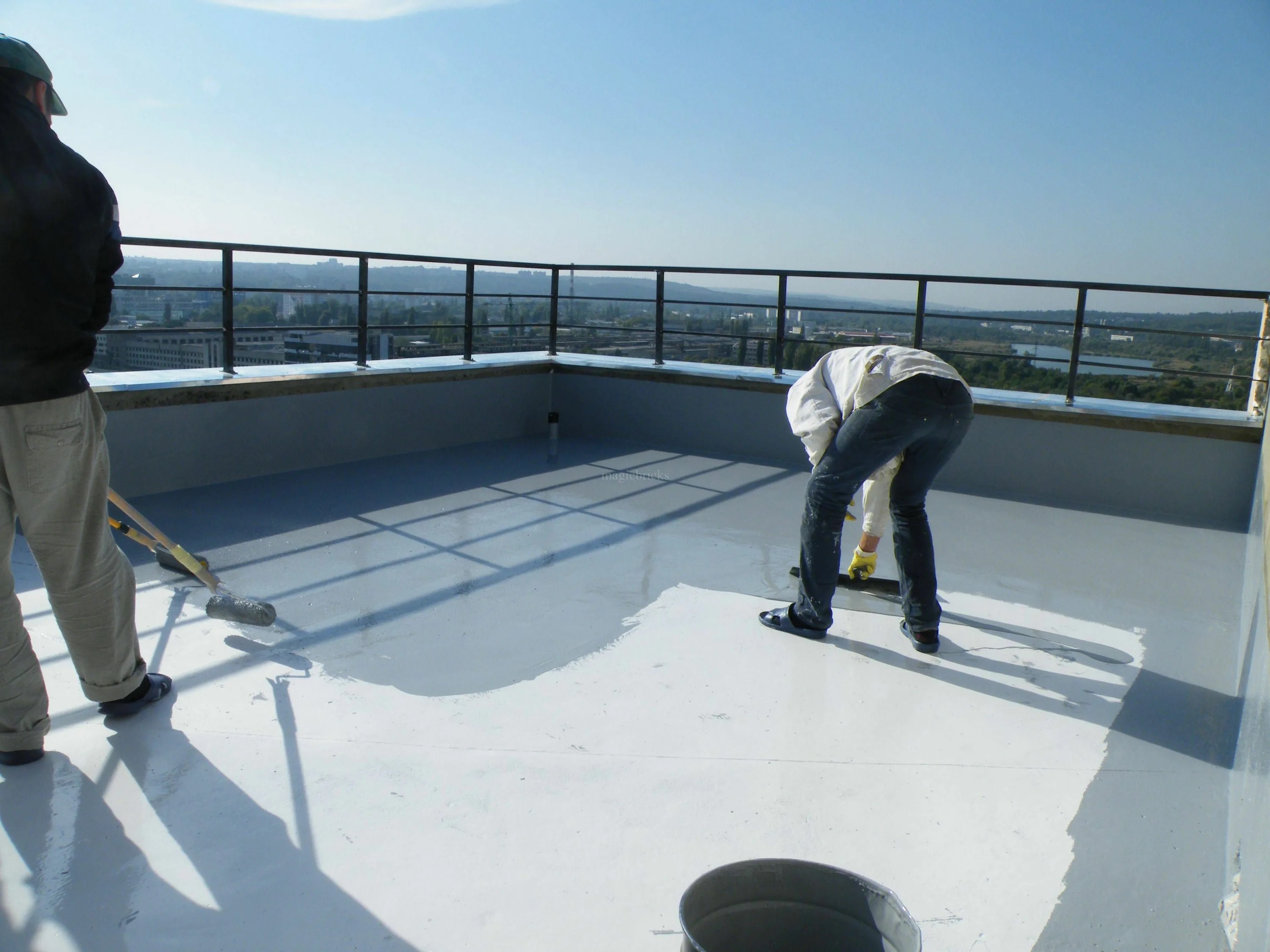
For roofs in use, a two-component polyurethane mastic, either cold or hot-applied, is optimal. This creates a monolithic seal that prevents leaks even when water stagnates.
5. Drainage layer and finishing coating
A profiled drainage membrane must be installed between the waterproofing and the finishing layer (for example, porcelain tiles on supports). It ensures rapid water drainage to the drainage outlets and relieves hydrostatic pressure on the main membrane.
Critical nodes: where leaks most often occur
Experience with penthouses in Cyprus shows that 90% of leaks occur not in the main area, but in areas where the building connects and passes through.
- Door thresholds: The entrance from the living room to the terrace must have a waterproofing “entrance” to a vertical wall at least 15 cm high. In 2026, special hidden rain grates built into the threshold were used to eliminate the need for a step while still blocking water.
- Roof drains: This is the weakest point. It is recommended to use roof drains with an integrated flange made of the same material as the main waterproofing and mandatory heating (relevant for the mountainous regions of Cyprus).
- Parapets and aerators: The attachment points of glass railings must be sealed with special injection compounds that do not lose elasticity when subjected to wind vibrations.
Economic aspect and legal guarantees
When purchasing a penthouse off-plan or on the secondary market in 2026, investors should look for Decennial Liability insurance policies (a ten-year developer liability for structural defects).
The cost of high-quality turnkey waterproofing using polyurethane systems in 2026 ranges from €65 to €95 per square meter. Meanwhile, repairing the aftermath of a leak (replacing parquet, repainting walls, removing mold, and re-roofing) costs an average of €350 to €500 per square meter of damaged area.
FAQ: Frequently Asked Questions
Is it possible to waterproof old tiles without removing them?
Yes, as of 2026, transparent polyurethane systems (such as Maritrans) are available that allow you to create a seamless layer over existing tiles. However, this solution is only suitable if the old coating is free of voids and adheres well to the substrate. If the tiles have begun to move or there is already moisture underneath, removal down to the concrete base is mandatory.
How often should a roof be inspected in Cyprus?
A professional inspection should be performed twice a year: in October (before the rainy season) and in May (after winter). Particular attention should be paid to clearing the gutter of dust, sand, and leaves, as a clogged gutter is the main cause of a “pool” on the roof and subsequent waterproofing failure.
Does installing solar panels affect the waterproofing warranty?
Yes, any mechanical fastening of panels through the waterproofing layer will void the manufacturer’s warranty. In 2026, it is recommended to use ballasted solar panel mounting systems for penthouses, which are supported by their own weight and do not compromise the integrity of the roofing structure.
What should you do if a stain appears on your ceiling after the first rain?
First, check the drains and surrounding areas. Clearing the drain is often the solution. If a blockage is ruled out, a leak test (flooding the roof for 24-48 hours) or using vector mapping to detect invisible microcracks is necessary.
What is the standard waterproofing warranty in 2026?
In Cyprus, reputable contractors provide a 10- to 15-year warranty on materials and a 5-year warranty on work performed. It’s important that the warranty be supported by an official certificate from the system manufacturer, not simply a promise in the contract.