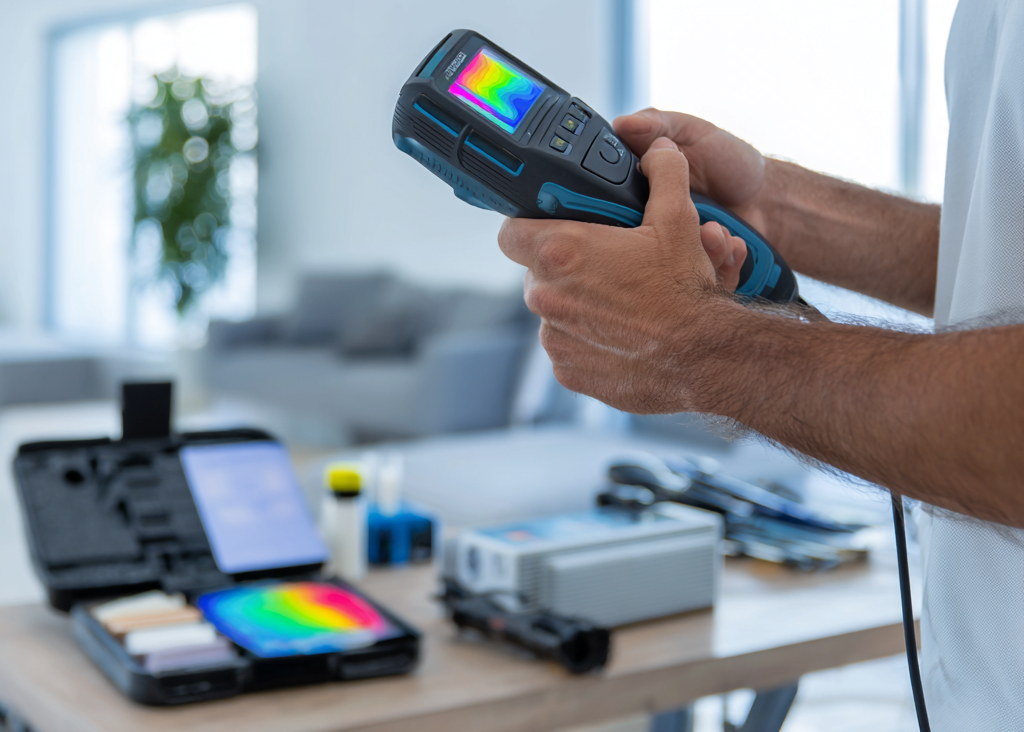
Purchasing resale property in Cyprus in 2026 requires investors to exercise extreme vigilance and utilize modern technical inspection technologies. Given the island’s subtropical climate, where extreme summer heat gives way to high winter humidity, the condition of a building’s structural elements plays a crucial role in the long-term value of the property. Thermal imaging (thermographic audit) has become a mandatory due diligence step for wealthy buyers seeking to minimize the risk of hidden defects that cannot be detected during a standard visual inspection.
Contents
- 1 Why visual inspection of resale properties in Cyprus is ineffective in 2026
- 2 Key defects detected by thermal imaging at Cypriot sites
- 3 Economic feasibility and cost of audit
- 4 Pre-transaction due diligence process in 2026
- 5 The best time for a thermal imaging audit in Cyprus
- 6 FAQ: Frequently Asked Questions
Why visual inspection of resale properties in Cyprus is ineffective in 2026
The Cyprus resale property market is comprised of properties from various construction periods. Villas built 10-15 years ago often fail to meet modern A + energy efficiency standards, adopted in 2026. Sellers often carry out cosmetic renovations, disguising leaks, cracks in the foundation, or mold spots with a fresh coat of paint or plasterboard panels.
Using a professional thermal imager allows you to “peek” inside walls and ceilings. The device records infrared radiation, converting temperature gradients into a visible image (thermogram). Any anomaly on the thermal imager’s screen indicates a potential problem, ranging from defective thermal insulation to critical overheating of electrical wiring.
Key defects detected by thermal imaging at Cypriot sites
The 2026 technical audit focuses on four critical areas that directly impact operating costs and occupant comfort.
Hidden leaks and waterproofing failures
Cyprus is characterized by the use of flat roof terraces and water supply systems installed within concrete slabs. Even a microscopic crack in a pipe or a breach in the roof membrane can lead to moisture accumulation. A thermal imager detects moisture evaporation zones, which are always cooler than dry wall areas. This allows for precise leak location without removing the finish, saving the buyer €3,000 to €15,000 in potential repairs.
Cold bridges and thermal insulation defects
Many buildings built before strict energy efficiency standards were introduced suffer from missing thermal breaks in concrete columns and floors. These areas become cold conductors in winter and hot spots in summer. Thermal imaging clearly reveals areas where expensive cooling from air conditioners is leaking. In 2026, at current electricity rates, high-quality insulation can reduce monthly bills by 30-45%.
Mold is the main enemy of the health and longevity of buildings on the coast of Limassol, Paphos, and Larnaca. It often develops behind cabinets, under kitchen units, or within multi-layer walls. A thermal imager detects areas of condensation (dew point) even before visible black spots appear. For investors, this is a critical factor when making a purchase decision, as mold removal in the humid conditions of Cyprus requires costly remediation.
Condition of engineering systems and electrical wiring
Second-hand homes often have worn-out electrical wiring, not designed to handle the modern demands of powerful climate control systems and electric vehicle charging stations. A thermal imager instantly identifies overheated contacts in distribution boards and junction boxes, preventing the risk of fire. This inspection is also effective for monitoring the operation of underfloor heating systems, allowing one to see the integrity of the heating circuits beneath the tiles.
Economic feasibility and cost of audit
Investments in a technical audit using a thermal imaging camera in 2026 are justified for properties of any price segment – from apartments for 300,000 euros to exclusive villas costing over 2,000,000 euros.
| Property type | Area (sq. m) | Audit cost (EUR) | Potential savings (EUR) |
| Apartments (2-3 bedrooms) | 80 – 120 | 250 – 400 | 2,000 – 5,000 |
| Classic villa | 150 – 250 | 450 – 700 | 5,000 – 20,000 |
| Premium estate | 400+ | from 1,000 | 50,000+ |
The results of a thermal imaging inspection in 2026 serve as a compelling argument for price reduction (bargaining) with the seller. Having an official technical report with thermal images allows for a reasonable request for a discount equivalent to the cost of the necessary restoration work.
Pre-transaction due diligence process in 2026
To obtain reliable data, the audit must be conducted by a certified specialist (Building Surveyor) using professional-grade equipment (matrix resolution of at least 320×240 pixels).
- Preparing the property: 12–24 hours before the inspection, the home’s climate control system should be turned on (heating in winter or cooling in summer). This creates the necessary temperature contrast between the interior and exterior.
- External scanning: Inspection of facades, foundations and roofs to identify heat loss and cracks in structures.
- Internal scanning: Detailed inspection of corners, window openings, utility lines and electrical panels.
- Moisture Analysis: Parallel use of contact moisture meters to confirm anomalies detected by thermal imaging.
- Report Preparation: Generating a document describing each identified anomaly, risk assessment, and recommendations for remediation.
The best time for a thermal imaging audit in Cyprus
In 2026, experts recommend conducting inspections during periods of the highest temperature delta. In Cyprus, this is during the summer months (July–August), when the outside temperature reaches 40°C and the inside temperature is maintained at 22°C, or during the winter period (January–February) when the heating systems are operating. Inspections during the off-season are less informative for detecting insulation defects, but are still effective for detecting hidden leaks after heavy rainfall.
Remember that buying a resale property in Cyprus in 2026 isn’t just about acquiring square footage; it’s also about acquiring ownership of a complex utility system. Using a thermal imager allows you to transform the appraisal process from a matter of guesswork to precise engineering data, ensuring the security of your investment and your family’s peace of mind.
FAQ: Frequently Asked Questions
Can a thermal imager see through walls or mirrors?
A thermal imager doesn’t have X-ray vision. It only records the surface temperature of objects. However, the heat distribution on the wall surface can accurately determine what’s inside (pipes, fittings, voids, or moisture). Thermal imaging can’t “see” through mirrors and glass, as these materials reflect infrared radiation. Therefore, specific methods for measuring temperature differences across frames and slopes are used to inspect window structures.
Is a budget smartphone thermal imager enough for a home assessment?
Low-cost smartphone modules have low resolution and high error rates (more than 2–5°C). They are unsuitable for a professional energy audit of a villa in 2026, as they may miss micro-changes in temperature that indicate the early stages of mold growth or minor leaks. Professional devices used by certified engineers in Cyprus undergo annual calibration and have a sensitivity of less than 0.05°C.
Is it possible to conduct an inspection if no one lives in the house and the electricity is out?
Conducting a quality audit in a “cold” home without functioning climate control systems is virtually impossible, as there is no temperature contrast. In 2026, to conduct a full inspection of a resale property, the buyer must negotiate with the seller to temporarily connect the power supply and preheat or pre-cool the premises for at least 12 hours before the engineer’s visit.
Is a thermal imaging inspection report a legal document?
If the audit is conducted by a licensed member of ETEK (the Scientific and Technical Chamber of Cyprus) or a certified international expert, such a report can be used as evidence in pre-trial disputes with the seller or developer. As of 2026, many insurance companies in Cyprus will also request such reports before issuing premium property insurance policies to assess the actual risks of the property.
Does a thermal camera detect termites or other pests?
Thermal imaging can indirectly indicate termite activity in wooden roof or floor structures. Large colonies of insects generate heat during their life cycle, which is detected by the device as a localized temperature spot in areas where it shouldn’t be. However, for complete assurance, a thermal imaging inspection in 2026 is recommended to be supplemented by a specialized pest control inspection.