The problem of poor soundproofing in Cyprus apartment buildings remains one of the most discussed issues among foreign investors and expats in 2026. Purchasing premium apartments in Limassol or Paphos does not guarantee acoustic comfort if the developer has only complied with basic building codes. The specific nature of Cypriot housing construction—the use of a reinforced concrete frame and hard flooring (ceramics, marble)—turns the building into a single resonator, where footsteps, furniture movements, and even the quiet conversations of neighbors are clearly audible.
Contents
- 1 Reasons for poor soundproofing in new buildings in Cyprus
- 2 Noise classification: impact vs. airborne
- 3 Floor Soundproofing Technologies: Creating a “Floating” Foundation
- 4 Ceiling Solutions: How to Protect Yourself from Noisy Upstairs Neighbors
- 5 Comparison of the effectiveness of soundproofing materials 2026
- 6 Critical finishing components: what to look for
- 7 The investment appeal of silence
- 8 FAQ: Frequently Asked Questions
Reasons for poor soundproofing in new buildings in Cyprus
The main reason for this high audibility lies in the physics of sound propagation in solids. In 2026, most buildings on the island are constructed using monolithic frame technology. Reinforced concrete has a high density and is an excellent conductor of impact noise.
The main factors that aggravate the situation are:
- “Tile Cult”: Carpeting is practically never used in Cyprus. Porcelain tiles and marble laid directly on a cement screed transfer impact energy directly to the floor slab.
- No “floating floors”: In the mass segment, developers rarely install a damping layer between the floor and the screed.
- Acoustic bridges: Sound travels through shared ventilation shafts, pipe openings, and rigid wall-to-ceiling connections.
Noise classification: impact vs. airborne
To effectively combat noise in 2026, experts divide it into two types, each requiring its own technical solution.
Impact Noise
These are the sounds of footsteps, falling objects, or chairs moving. In Cyprus, this is the most common complaint. The impact energy is transferred to the concrete and distributed throughout the building’s structure. The solution to this problem must be systemic and installed under the floor covering.
Airborne Noise
Voices, music, TV sound. It’s transmitted through the air and penetrates cracks, thin partitions, and ventilation. Its attenuation requires multilayer structures using materials of varying densities.
Floor Soundproofing Technologies: Creating a “Floating” Foundation
The most effective way to protect yourself from noise from your downstairs neighbors (for them) and ensure peace in your apartment in 2026 is to install a “floating floor.” This method creates a complete acoustic gap between the finished flooring and the building’s supporting structure.
Stages of creating a soundproofing layer under the screed:
- Preparation of the base: Thoroughly clean the floor slab from concrete drips and dust.
- Damping membrane installation: Use materials based on foamed polyethylene, rubber, or specialized mats (such as Tecsound or Phonostar). The layer thickness in 2026 should be at least 5–10 mm.
- Wall Covering: The soundproofing material should extend up the walls above the level of the future screed. This prevents sound transmission from the floor to the walls.
- Reinforced screed: A 50–70 mm thick layer of concrete is poured over the membrane, which should not touch the walls.
Ceiling Solutions: How to Protect Yourself from Noisy Upstairs Neighbors
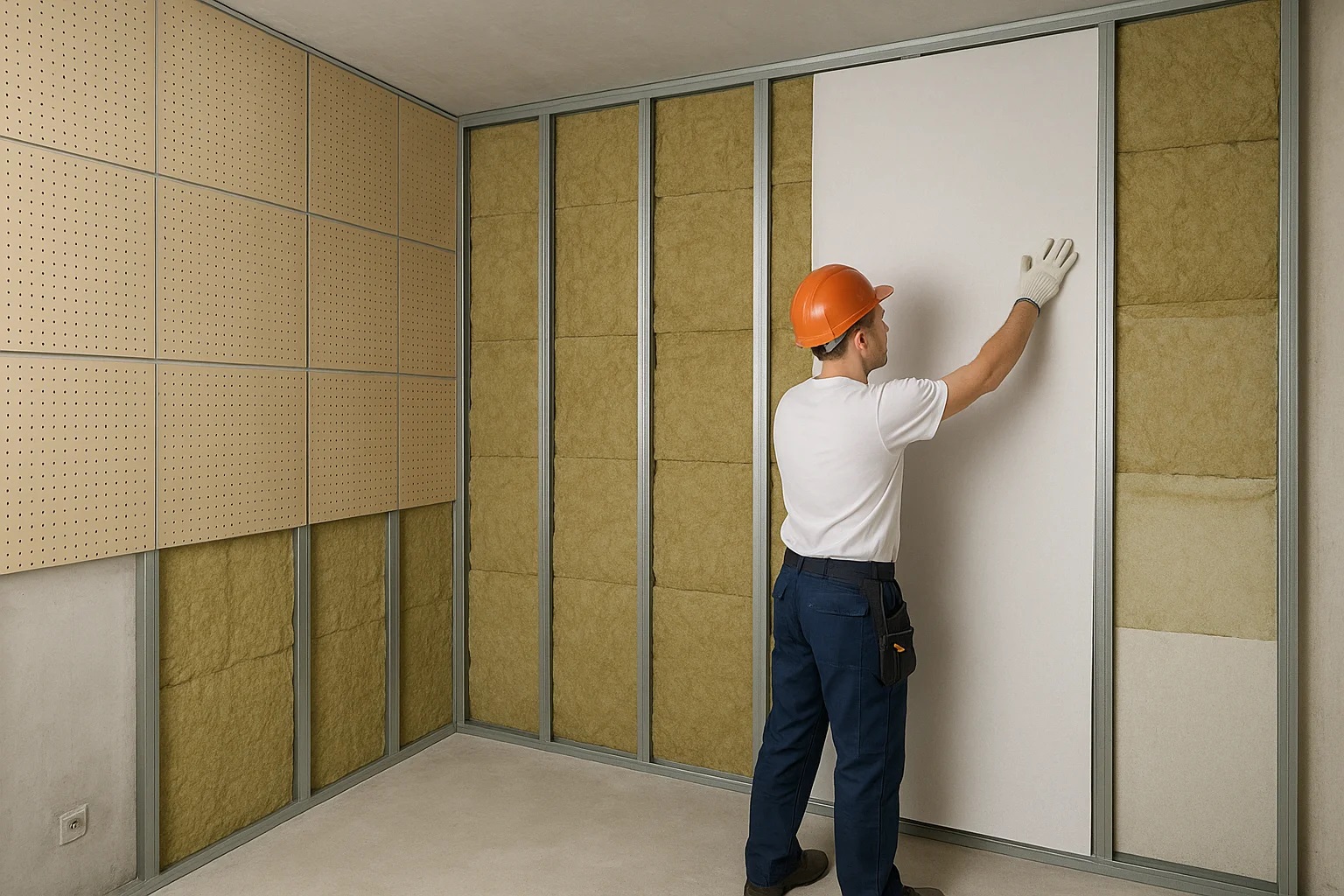
If you’ve already purchased an apartment with a finished screed from your upstairs neighbors, the only way to improve the situation is to soundproof your own ceiling. As of 2026, frame systems with vibration-suspension ceilings are used for this purpose.
Components of an effective ceiling system:
- Vibration-isolating mounts: They prevent the transmission of vibrations from the floor slab to the metal frame of the drywall.
- Absorbing layer: Filling the space between the floor and the suspended ceiling with acoustic mineral wool with a density of 45–60 kg/m³.
- Sound-reflecting layer: Use of specialized acoustic plasterboard (high density) in 2 layers with offset seams.
Comparison of the effectiveness of soundproofing materials 2026
The choice of materials on the Cyprus market in 2026 allows for solutions to problems of any complexity—from basic protection to creating home theaters.
| Solution type | System thickness | Impact noise reduction (ΔLw) | Airborne noise reduction (Rw) | Approximate cost (materials + labor) |
| Thin membrane under laminate | 3–5 mm | 18–22 dB | 2–3 dB | €15–20/m² |
| Floating floor (EPS/Mineral wool) | 60–80 mm | 28–35 dB | 8–12 dB | €45–65 / m² |
| Frame ceiling on vibration suspensions | 100–120 mm | 15–20 dB | 15–18 dB | €80–120/m² |
| Soundproofing panels (ZIPS) | 40–70 mm | 10–12 dB | 11–13 dB | €70–95/m² |
Critical finishing components: what to look for
Even the most expensive soundproofing will be ineffective if there are errors in the finishing details. As of 2026, professional technical supervision in Cyprus will focus on the following points:
Sealing of socket boxes and communication outlets
Electrical outlet openings in shared walls often become “dormer windows.” It’s recommended to use soundproofing boxes or fill the space around the outlet box with a specialized non-hardening sealant.
Ventilation ducts and air conditioning
Modern apartments in Cyprus often feature ducted air conditioning (VRV) systems. These ducts can transmit noise from adjacent rooms or apartments. Installing sound attenuators in these ducts will be a mandatory standard for business-class housing in 2026.
Interior doors
Lightweight hollow-core doors are not soundproof. To ensure privacy in bedrooms, choose doors with solid wood or tubular chipboard infill and install a drop-down threshold seal (smart seal) that covers the gap between the door and the floor.
The investment appeal of silence
By 2026, professional soundproofing in an apartment will become a significant marketing advantage for resale or long-term rentals. Properties with acoustic comfort solutions are rented 15-20% faster, and their resale value is 5-7% higher than standard similar properties. For investors, this isn’t just a cost of repairs; it’s a way to protect the asset from negative tenant reviews and improve future liquidity.
FAQ: Frequently Asked Questions
Will a suspended ceiling help reduce noise from the neighbors above?
A standard PVC stretch ceiling is not soundproofing. In fact, it can act like a drum membrane, amplifying the noise. For a stretch ceiling to be effective, a layer of acoustic wool must be first secured to the floor slab, and the fabric itself must be perforated (acoustic stretch ceiling).
Is it possible to provide high-quality soundproofing if the finishing work has already been completed?
This is significantly more complicated and expensive. It would require either raising the floor level, which would require replacing doors and redoing built-in furniture, or lowering the ceilings, reducing the height of the rooms. As of 2026, thin frameless sandwich panels are used in Cyprus for such cases , but their efficiency is lower than that of full-fledged systems installed during the rough finishing stage.
What material is best for parquet flooring in Cyprus?
Natural cork underlays or specialized high-density polyurethane mats are ideal for the Cypriot climate. They not only dampen footfall noise but also serve as an additional thermal barrier and maintain their shape in high humidity and temperatures.
Can you hear your neighbors through plasterboard walls?
Plasterboard partitions can be both very resonant and excellent insulators. It all depends on the filling. A partition consisting of a double layer of plasterboard on each side and filled with high-quality mineral wool outperforms a standard hollow brick wall in terms of sound insulation.
Why can I hear my neighbors’ conversations through the bathroom?
This is most often caused by shared ventilation shafts and sewer risers that were not covered with soundproofing material. As of 2026, the use of silent sewer pipes (such as the Skolan series) and the installation of individual check valves on the ventilation system are the standard for minimizing this noise.