When choosing luxury properties in rural or mountainous areas of Cyprus in 2026, wastewater disposal will be a key factor affecting operating costs and the property’s environmental performance. While the coastal areas of Limassol and Paphos are almost entirely covered by centralized systems (SANA, SAPA), many exclusive suburban and rural locations continue to rely on stand-alone solutions. For investors and expats, understanding the difference between a septic tank and a central water supply is essential for accurately calculating annual property maintenance budgets and complying with the strict environmental standards of the Republic of Cyprus.
Central sewerage: standards for urban and coastal areas
By 2026, the coverage of the centralized sewerage network in Cyprus has significantly expanded thanks to the completion of major EU-funded infrastructure projects. Connecting to the municipal network is considered the most prestigious and hassle-free option for property owners.
Financial obligations of the owner
Owning a villa connected to the central water system requires the owner to pay an annual tax to the relevant Sewage Authority (e.g., SANA in Limassol or SAPA in Paphos). In 2026, this tax is calculated based on the assessed value of the property as of 2021. The rate typically ranges from 0.5 to 1.2 ppm. Additionally, water bills include a wastewater treatment fee of approximately €0.60–€0.90 per cubic meter of water consumed.
Advantages
- Complete absence of odors on the site and the need to call service providers.
- Highly environmentally friendly: wastewater undergoes multi-stage treatment at modern stations and is often used to irrigate municipal parks.
- Positive impact on the property’s liquidity upon resale in 2026.
Autonomous systems: septic tanks and absorption pits in rural areas
In rural areas and low-density residential areas, central sewerage systems are often unavailable. Three main types of stand-alone systems are used here, each with its own maintenance requirements and legal nuances.
Absorbing Pits
A traditional method in Cyprus, it is gradually being replaced by more environmentally friendly solutions in 2026. It operates by filtering liquid waste directly into the ground through the porous walls of the pit.
- Features: Requires a specific soil type (limestone or sandstone). In clay soils, such a pit quickly silts up.
- Risks: Potential groundwater contamination, which is strictly monitored by the Department of Environmental Protection. In a number of prestigious communities, the construction of new absorption pits is prohibited in 2026.
Holding Tanks
Sealed tanks that prevent wastewater from coming into contact with the soil.
- Maintenance: Requires regular pumping with a sewage truck. For a family of four with heavy water consumption, service calls may be needed every 3-4 weeks.
- Cost: One trip by a sewage truck in 2026 costs 70–120 euros, depending on the remoteness of the area.
Modern bio – stations (Biological Treatment Plants)
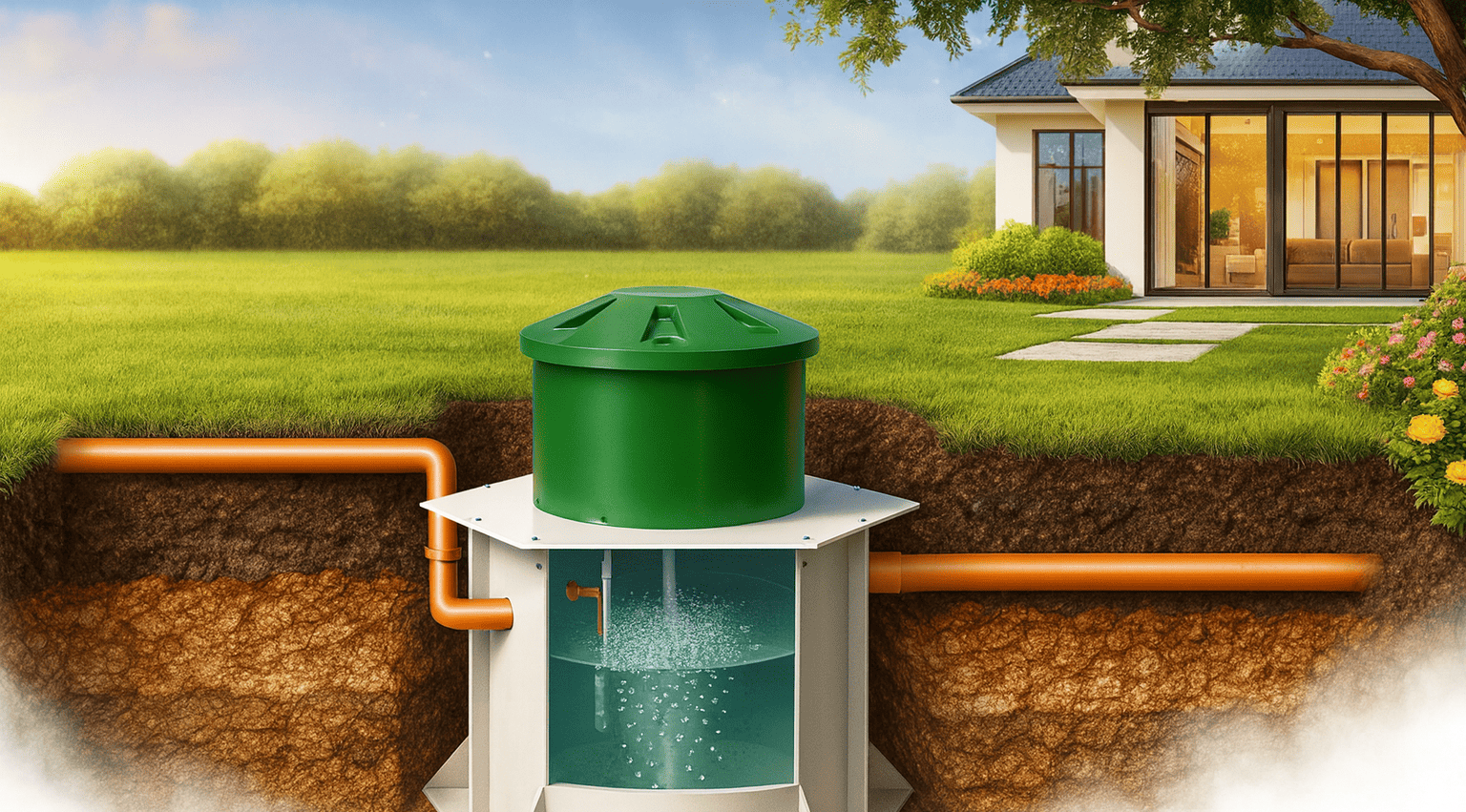
The most advanced solution for premium villas in 2026. These are compact treatment plants (such as the Klargester system) that convert wastewater into process water suitable for automatic garden irrigation.
- Benefit: Savings on irrigation water can reach 300 – 500 euros per year.
- Maintenance: Requires annual service (filter replacement, compressor check), which costs approximately 150 – 250 euros.
Cost and Performance Comparison Chart 2026
Below is a comparison of systems for a standard 200 sq.m villa with a 600 sq.m plot.
| Characteristic | Central network (SANA/SAPA) | Storage septic tank | Bio- purification station |
| Annual tax/fee | 250 – 600 EUR | No (for export only) | No (service only) |
| Maintenance cost | Included in water bills | 800 – 1,400 EUR/year | 150 – 250 EUR/year |
| Electricity costs | 0 EUR | 0 EUR | 40 – 70 EUR/year |
| Recycling of water | No (for private individuals) | No | Yes (watering the garden) |
| Risk of odor formation | Null | Average (overflow) | Low (with proper service) |
| System service life | Unlimited | 15 – 25 years old | 10 – 15 years (before cap . repair ) |
Legal requirements and taxes in rural areas
In 2026, Cyprus will introduce new environmental charges for owners of properties not connected to the central sewer system but located in areas with vulnerable groundwater.
- Certification upon purchase: When completing a purchase or sale of existing real estate in rural areas, lawyers are required in 2026 to verify the availability of a planning permit for the specific type of septic tank installed on the property. Failure to comply with the design may prevent the final approval certificate from being obtained.
- Environmental monitoring: Bio-plant owners are required to maintain maintenance records. Fines for individuals who leak untreated wastewater into the soil will start at €2,000 in 2026.
- Development Plans: Before purchasing a villa in a rural area, it’s important to inquire with the local council about plans for installing a central sewer system. If such plans exist, the owner will be required to connect to the network at their own expense (between €1,500 and €4,000) and will be required to pay an annual fee, even if their current septic tank is in good working order.
Recommendations for choosing a system for an investor
For premium properties located away from cities (for example, in villages like Souni, Pissouri, or the Paphos foothills), installing a bio-station is the most cost-effective investment in 2026. This not only increases the home’s autonomy but also aligns with the eco-friendly trend, which is extremely important for European renters and buyers.
When inspecting a resale villa with a septic tank, it is recommended to conduct a technical audit of the system. Siltation of the septic tank in older homes (over 20 years old) is a common problem. Solutions to this problem require drilling a new septic tank or completely replacing the system with a bio-station . This can result in a discount of €5,000–€7,000 from the asking price.
FAQ: Frequently Asked Questions
How often does a typical septic tank in Cyprus need to be pumped out?
Pumping frequency depends directly on the tank’s capacity and water usage. In 2026, a standard 10-cubic-meter storage tank for a family of 3-4 people would require pumping once every 3-5 weeks. If a villa is used as a vacation home (2-3 months a year), pumping may be necessary once a year.
Is it possible to discharge water from a pool into a septic tank or sewer?
Discharging pool water into a central sewer or septic tank is prohibited in Cyprus. Chlorinated water kills beneficial bacteria in the septic tank and overloads municipal wastewater treatment plants. As of 2026, regulations require the use of special drainage wells or evaporation systems for draining pools. Failure to comply with this regulation can lead to rapid failure of the bio-station.
Why do I still get bills for central sewerage even if no one lives in the house?
The SANA/SAPA tax is a property tax, not a service tax. It is used to pay off loans for the construction of city infrastructure. Even if the villa is empty, the owner is required to pay a fixed annual property tax in 2026. The fee for actual wastewater treatment (the variable portion) will be zero in this case, since there is no water consumption.
Is industrial water from a bio-station safe for pets?
Water purified in modern biological systems certified in Cyprus in 2026 is safe for watering lawns and ornamental plants. However, it is not potable. It is not recommended for pets to drink this water or for using it to water unprocessed fruit crops due to the potential presence of residual trace elements from household chemicals.
What should I do if there is an unpleasant odor coming from the septic tank on my property?
The most effective solution is to use specialized bacterial concentrates added to the system through the toilet. If the odor persists, it may indicate a ventilation problem (missing vent pipe) or an overflowing tank. In the case of a bio-station, the odor usually indicates a faulty aerator or the death of the activated sludge due to the use of aggressive cleaning agents with a high chlorine content.