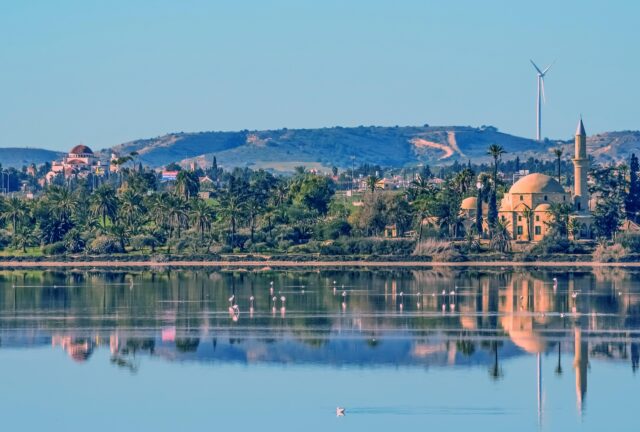
The Hala Sultan Tekke Mosque, located on the western shore of Larnaca Salt Lake, is one of the most significant religious monuments in Cyprus and the entire eastern Mediterranean. This sacred complex not only preserves the memory of the early years of Islam’s spread on the island but also serves as a rare example of the peaceful coexistence of cultures and faiths intertwined on Cypriot soil for over a thousand years.
Contents
Historical roots and legends
The history of Hala Sultan Tekke is inextricably linked with the name of Umm Haram bint Milkhan, a revered relative and companion of the Prophet Muhammad. She accompanied him on one of the Arab naval expeditions of the 7th century, during the reign of Caliph Muawiyah I, and died off the coast of Cyprus. The site of her death became an object of special veneration, and a mausoleum was soon erected there, later converted into a Sufi monastery— a tekke.
For centuries, this site remained a symbol of the Muslim world’s connection to Cyprus, even during periods when the island was under Byzantine, Frankish, and Venetian rule. After the Ottoman Empire captured Cyprus in 1571, the sanctuary received official status as a religious site, and in the 18th century, large-scale construction of the complex in its present form began. The main mosque building was completed in 1817 with the assistance of the Turkish authorities and local Muslim communities.
Architecture and planning
Tekke architectural complex combines a mausoleum, a mosque, a minaret, residential and outbuildings, and an old cemetery. The complex is built in the classical Ottoman style with elements of the Eastern Baroque style characteristic of the late Ottoman period.
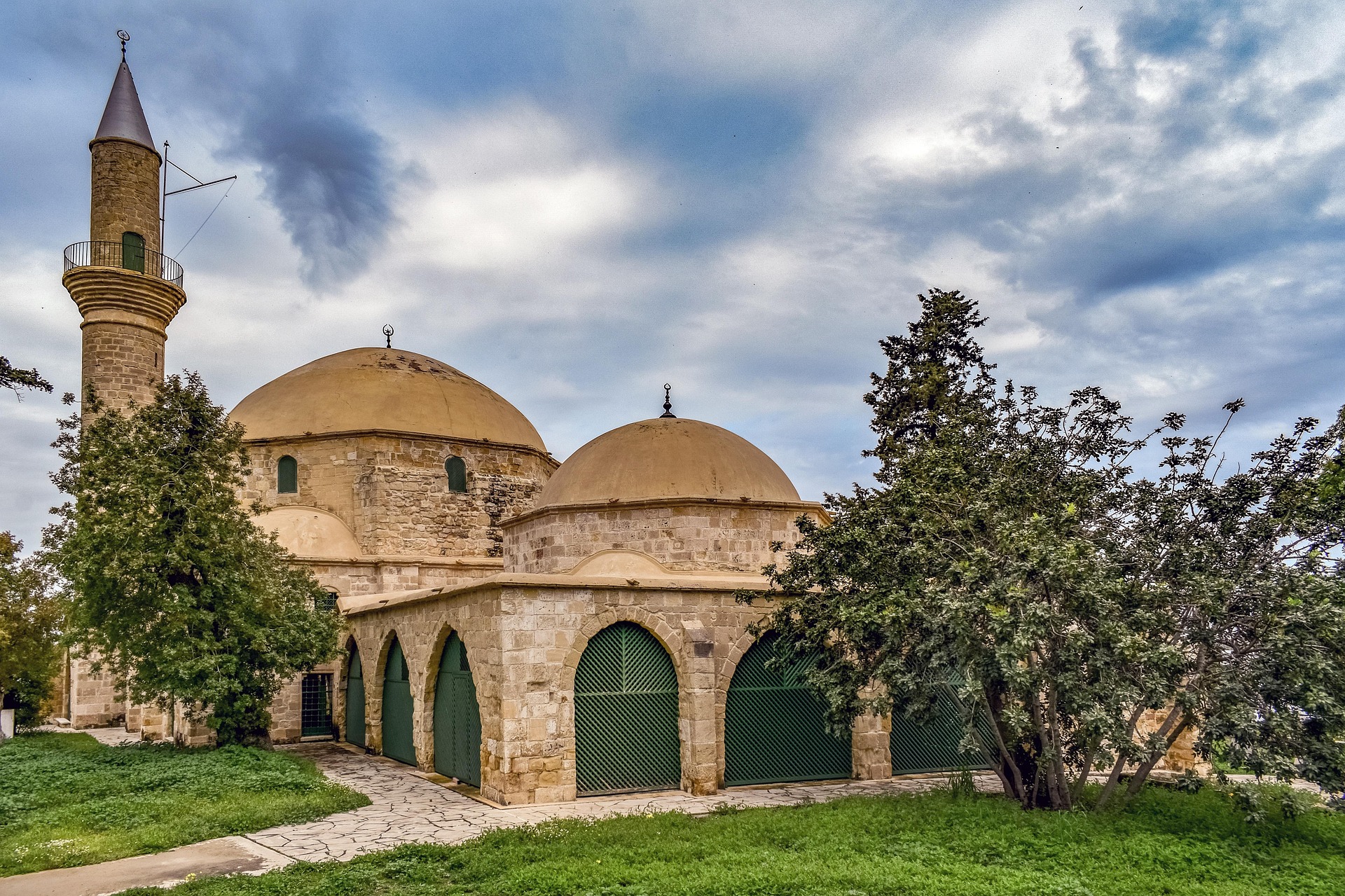
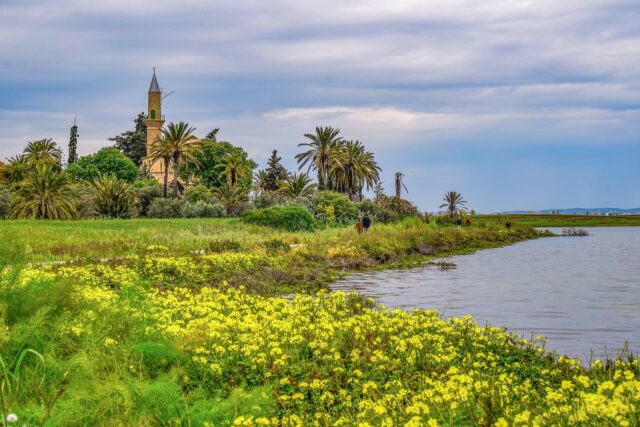
The mosque is located on the shore of a reservoir, away from residential areas. A garden has been laid out in front of the building, and nearby are its own amenities, including parking and small houses for the clergy. The building is constructed in the traditional Islamic style—made of white stone, with a large round roof and a minaret. Graceful arches run along the perimeter, and a one-story building, in accordance with religious canons, has been added to the side. To the right is a house divided into women’s and men’s quarters. To the left is a building intended only for men, where pilgrims can stay. A fountain for washing hands and feet is located in front of the entrance. The grounds also include a cemetery where Cypriot rulers were buried.
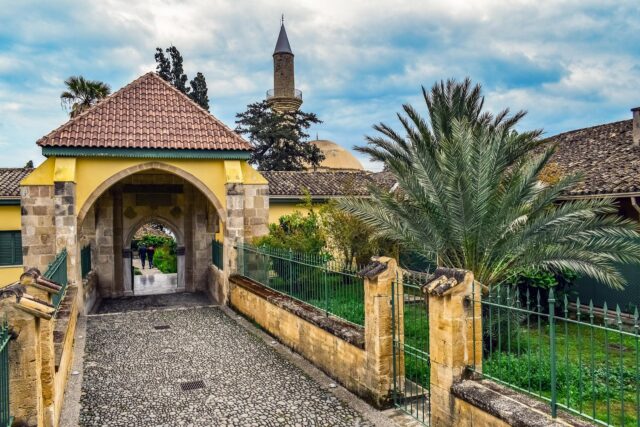
“Pasha’s Garden” greets visitors at the entrance to the grounds. It features palm trees, cypresses, shrubs, olive trees, and other plants characteristic of the local climate. Ribbons can be seen hanging from the branches—they are left by newlyweds in hopes of a happy married life. The park is also known as the “Rose Garden of Enlightenment.”
The main attraction of the interior is the tomb of Umm The Haram is made of marble and enclosed by a bronze fence. The floors are carpeted, several chandeliers provide light, and the walls are painted in calm, light colors. The decor is very modest and filled with natural light. Women have a separate prayer area on the second floor.
The mosque is constructed of local limestone, lending it a soft golden hue at sunset. The dome rests on an octagonal drum, and a slender minaret with an elegant balcony extends upward, reflected in the water of the salt lake. The mosque’s interior is strikingly simple: ornamentation is limited to Arabic calligraphy, and attention is focused on clean lines and a spacious space designed to evoke a sense of serene tranquility.
The mosque grounds retain traces of an old garden and a fountain for ritual ablutions. The surroundings—the mirror-like surface of a salt lake, where flocks of pink flamingos flock in the spring—create a special atmosphere. This natural context makes the mosque perceived not only as a place of prayer but also as a symbol of harmony between man and the environment.
Archaeological and cultural context
Tekke Mosque is located in close proximity to one of the most important archaeological sites of the Bronze Age— a settlement of the same name, which existed from approximately 1600 to 1100 BCE. Excavations conducted by the Swedish Archaeological Institute have uncovered traces of an ancient port and extensive trade links with the Eastern Mediterranean. This unique blend of cultural layers—from prehistoric civilizations to the Islamic era—makes the area around the mosque an archaeological and historical phenomenon.
Today, this area is included on the tentative list of UNESCO World Heritage sites. Scholars consider Hala Sultan Tekke a rare example of a “living cultural landscape,” where religious tradition, nature, and history coexist in a single space.
Religious significance
For Muslims worldwide, the Hala Sultan Tekke is one of the most important centers of worship after Mecca, Medina, and Jerusalem. Thousands of pilgrims visit this site annually, especially during Ramadan and Eid al-Adha. In Cyprus, the mosque is seen as a symbol of tolerance: it often hosts interfaith meetings and cultural events emphasizing the importance of dialogue between the Christian and Muslim communities.
Despite the difficult political situation on the island, the sanctuary remains open to all visitors. The complex is managed by the Cyprus Department of Antiquities in collaboration with representatives of the Muslim community. This collaboration underscores the site’s special status—not only as a religious site but also as a cultural treasure for the entire island.
Hala Sultan Tekke today
The complex’s modern appearance is carefully preserved by restoration services. In recent years, work has been carried out to strengthen the dome, restore the minaret, and improve the grounds.
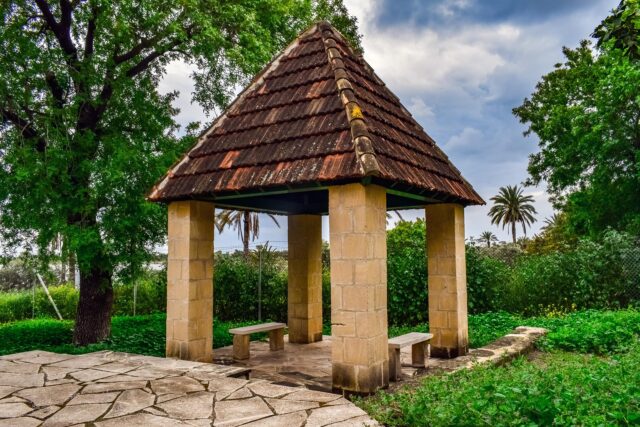
The facility occupies a small area, so 30-40 minutes will be enough to explore everything, both inside and out. Here, you can go to the main building, stroll through the park, or relax on the shore. Another attraction are the cats, of which several dozen live here.
Visiting rules
Admission to the mosque is free and open to everyone. Hala Sultan is open daily except for the Orthodox holidays of Christmas and Easter, and January 1st.
Visits are prohibited during Friday prayers with the imam, from 1:00 PM to 3:00 PM.
Opening hours:
- April 1 – May 31: 8:00 a.m. to 6:00 p.m.
- June 1 – August 31: 8:00 a.m. to 7:30 p.m.
- September 1 – October 30: 8:00 a.m. to 6:00 p.m.
- November 1 – March 31: 8:00 a.m. to 5:00 p.m.
Upon entering, please remove your shoes and leave them in designated lockers. Women are required to cover their heads, shoulders, and knees; headscarves are available at the entrance if needed.
How to get to the Hala Sultan Tekke Mosque
The mosque is located in Larnaca, Cyprus, near the airport that receives international flights from Russia. GPS coordinates for driving are: 34.885526, 33.610058 .
From the airport
The mosque is located just a few kilometers away. By car, the journey along the B4 road takes about 5 minutes (3.4 km). On foot, the journey takes 35–40 minutes: you need to go around the terminal on the side of the water and exit onto Tekke Road .
From Larnaca
From the city center, the journey takes 11-15 minutes by car: take the B4 highway and turn onto Tekke at the roundabout. The road is only about 7 km. You can take a bus to the “Terminal” stop or walk, following the salt lake and going around it to the other side to reach the park.
City bus #429 goes to the shrine. Routes #407, 417, 418, 419, 425, 446, 456 are also suitable – get off at the Artemidos stop. Avenue 7, from where you can walk along the picturesque promenade. The pedestrian path in the northeastern part of the lake is easily accessible from the Mackenzie neighborhoods or Faneromenis / Artemidos Avenues .
From Limassol
Take the A1 highway out of the city, then turn onto the A3. After the intersection, take the B4 highway, then turn left and follow the reservoir to your destination. The journey takes about 45 minutes—a distance of approximately 69 km.
Visitors remark on the unique sense of tranquility this place evokes: the mirror-like surface of the lake, the ringing of the muezzin, and the scent of the sea breeze create an atmosphere in which time seems to slow down. Hala Sultan Tekke remains more than just a historical monument, but a living symbol of the cultural continuity and spiritual balance that define Cyprus—an island at the crossroads of civilizations.